
J.O.O.N.A.S. & Catchers: Moon Sweepers Automation Guide
Set up Moon Sweepers J.O.O.N.A.S. in 1.0.4. Follow its sector, route capsules to catchers and choose direct selling or a processing factory.
What changed for J.O.O.N.A.S. in 1.0.4?
J.O.O.N.A.S. no longer has to return to its dock to unload in Moon Sweepers 1.0.4. It launches capsules toward the nearest catcher while continuing from one sector to the next. A pre-update route built around repeated dock trips no longer describes this version’s intended behavior.
Before following these steps, update the host and clients to the same current version. You need access to J.O.O.N.A.S. and capsule catchers in your save; this is an automation guide, not an instruction to buy every tool first or wait for a fixed number of manually cleaned sectors.
- Choose a work area and place your robot there. Start with one area so you can identify which catcher receives its output. Leave the ground you intend to use for building clear of unnecessary robot placements.
- Place a capsule catcher near that work area. Version 1.0.4 sends capsules to the nearest catcher. A distant processing base is not the same as a nearby receiving point.
- Look at J.O.O.N.A.S. to inspect its information panel. The current sector is shown; its bin gauge flashes red when full. Use those states to separate “still cleaning” from “cannot unload.”
- Open the Moon map and turn on the robot layer. Version 1.0.4 shows robots and their current activity, with toggles by robot type. Check the robot’s location and sector before buying another one to do the same job.
- Watch the receiving catcher and its output. Its 1.0.4 capacity is 100 kg, and its glass shows collected dust. If it stays full, inspect the selling or belt route before increasing robot input.
- Add another robot only after the loop clears its output. If a new robot keeps the catcher permanently full, add receiving/output capacity or reduce competing input. Do not assume any published robot count is universally optimal.
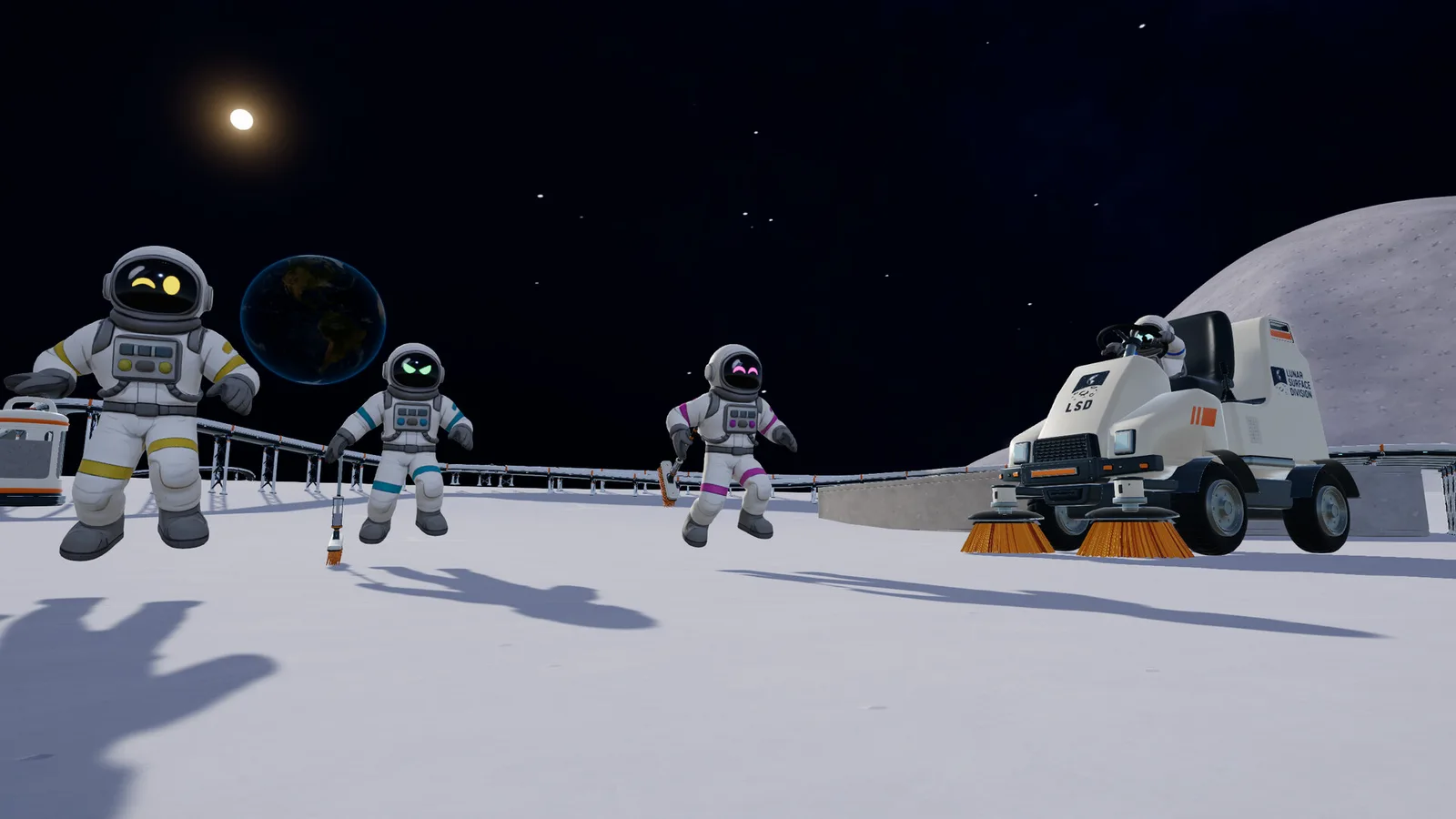
Should a catcher sell dust or feed a factory?
Choose the route by your current goal: clearing with less belt infrastructure, or processing dust for greater value. Late-game players report that a catcher with no belt attached sells its dust directly. Several players distinguish this from sending its output into a sand-and-stone factory. Treat direct selling as a behavior to check in your current save, not a promise that every disconnected machine will sell automatically.
| Your goal | Route to try | What to confirm before scaling |
|---|---|---|
| Keep robots emptying with little factory building | One catcher without an output belt | Its stored dust falls and your paid balance changes; do not rely only on a falling gauge |
| Process dust into more valuable material | Catcher → processing machines → station intake | Every machine receives its required inputs and the final belt actually reaches a working intake |
| Extend cleanup into a new area | A receiving catcher near the new work area | Capsules arrive there and storage clears; more distant robots may use a different nearest catcher |
For the processing route, follow dust, sand and stone production. Compare the value per kilogram and output mass before choosing a route solely by the price printed on one item.
How many J.O.O.N.A.S. units per catcher?
There is no single verified best ratio in this review. One factory author’s observation is about four robots per catcher; other players describe different saturation points. Travel, cleaning activity, belt loading and downstream consumption affect the result. Those are reports from particular saves, not a universal “buy exactly N” rule.
Use an incremental check instead:
- If the catcher often empties and robots have work, test one additional robot.
- If it remains at 100 kg, trace its output and downstream storage first.
- If the belt feeds an idle press, inspect both of that press’s required inputs. An empty second input is not evidence that you need more robots.
- If only a distant area stops progressing, use the map’s activity and sector information rather than assuming that no nearby player is the intended reason. The 1.0.4 notes say robots should keep working without players nearby.

What if every machine suddenly stops?
Update 1.0.4 lists a fix for machines pausing with “Could not pack a capsule,” but newer players still report production halts on that version. Do not claim that the patch fixes every save, or that a full catcher proves a game-wide fault.
First check the production input/output workflow. A claimed global limit of 10,000 capsules comes from a player’s code-reading report and is not independently confirmed here. It is not a reason to edit your save, install a mod or remove your entire factory. Keep the exact version, machine state and belt layout when reporting a persistent halt.
Return to all Moon Sweepers guides to choose your next task. About the editors explains our version and correction policy.
Related Articles
Was this helpful?
Thanks for the feedback!